

Orchestrating Collaboration for a Human-Centred Society in the Age of AI
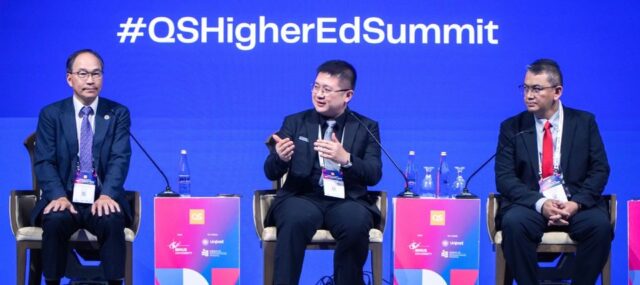
Bali, 5 November 2026 – ‘Orchestrating a Human-Centred Society: Building Collaborative Ecosystems’ was a special plenary session initiated by BINUS University (BINUS) as the main host of the QS Higher Ed Summit: Asia Pacific 2026. The session reflects the spirit of the university’s 45-year journey and its commitment to Co-Creating the Intelligent Society.
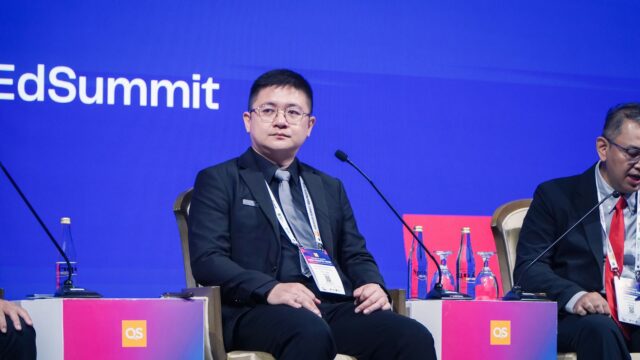
Representing BINUS, Prof. Derwin Suhartono, Dean of the School of Computer Science, shared his perspective on how universities can create greater societal impact through collaborative ecosystems in the age of artificial intelligence (AI).
Leveraging our partnerships with National Taiwan University and PT ITSEC Asia Tbk, we invited Dr. Shih-Torng Ding and Dr. Bambang Susilo to join the discussion as panelists and share international and industry best practices.
To begin with, when we talk about orchestrating a human-centered society through collaborative ecosystems, each sector has a role to play. In higher education, the discussion raised an important point about how universities can involve industry and government in preparing students for the future, with education and research to address societal needs.
(Photo Credit: Mufti Al-Warits)
“We have to move from the university as a knowledge provider to an ecosystem orchestrator. We have to involve industry in providing real case studies, society in measuring societal impact, and government as a policymaker and regulator,” said Prof. Derwin.
This shift is also changing how students learn and how educator approach teaching. With AI capable of completing assignments in seconds, oral examinations and direct interactions can help educators better assess students’ understanding. The challenge for educators is to ensure that students truly understand what they are learning. Hence, they are encouraged to work alongside AI rather than simply monitor its use.
The discussion also touched on the importance of developing human capabilities. Dr. Sarah noted that the success of universities may depend on how intelligently they use technology to develop people.
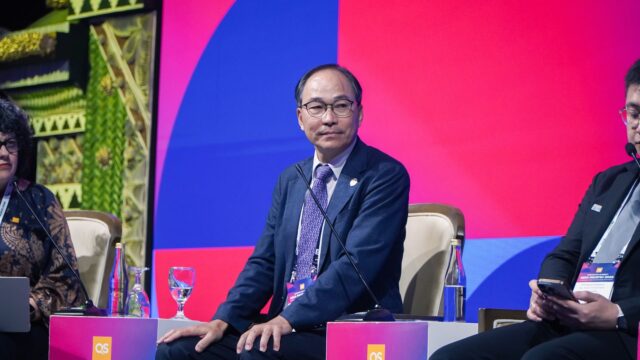
(Photo Editor: Mufti Al-Warits)
Responding to this, Dr. Ding emphasized critical thinking, communication, and teamwork, as well as equitable access to AI resources.
“Developing AI literacy is only the first step. The greater challenge is helping students apply that knowledge to real-world problems,” he added.
The discussion then turned to how universities can translate AI literacy into tangible outcomes. At BINUS University, industry partners and alumni contribute to this learning experience. Students work on real projects, learn from professionals, and have the opportunity to spend an academic year in industry through internships.
Dr. Bambang offered examples from the cybersecurity industry. Through consulting engagements and security testing, interns learn to question AI-generated results, validate their findings, and exercise professional judgment.
Similar opportunities exist within the university itself. Through collaboration between students from computer science, business, and other disciplines, they can combine technical expertise with a broader understanding of societal and industry challenges.
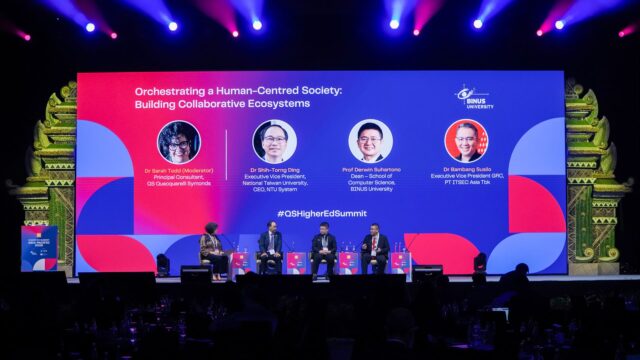
(Photo Editor: Mufti Al-Warits)
“At BINUS University, we create room for students to innovate, and from that innovation we can make a real impact. One example is encouraging final projects or theses involving different study programs,” Prof. Derwin explained.
Rather than viewing AI as a purely technological issue, the speakers focused on how universities can translate knowledge into practice. From industry engagement and human capability development to innovation-driven problem solving, the discussion explored practical ways to prepare students for the future.
Author: Mita Adhisti | Editor: Yusuf Rifai

Comments :