


Can Universities Keep Up with AI? BINUS UNIVERSITY Shares Both Best Practices and Challenges at THE Asia Universities Summit 2026
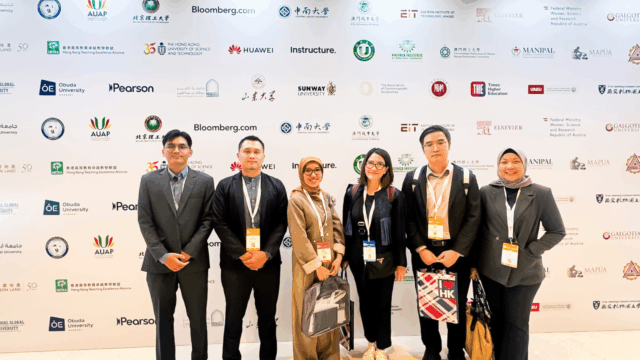
Jakarta, 27 April 2026 – The rapid advancement of Asia’s innovation ecosystem is redefining the role of higher education institutions. By integrating societal data, high-impact research, and cross-sector collaboration, universities play an important role in co-developing solutions alongside students, faculty, industries, and policymakers to meet market and societal needs. In response to these ongoing transformations and emerging trends, Vice-Rector Rini Setiowati, together with other delegates from BINUS University, attended the THE Asia Universities Summit 2026, hosted by Hong Kong University of Science and Technology from 22–24 April.
(Photo Editor: Mufti Warits)
Bringing together leaders from higher education, industry, and government, the summit, themed “Igniting Global Transformation: Asia’s Leadership,” explored how Asia is strengthening its position as a global innovation hub. The three-day dialogue highlighted the evolving role of universities in fostering innovation, collaboration, and sustainable development amid rapidly changing global situations.
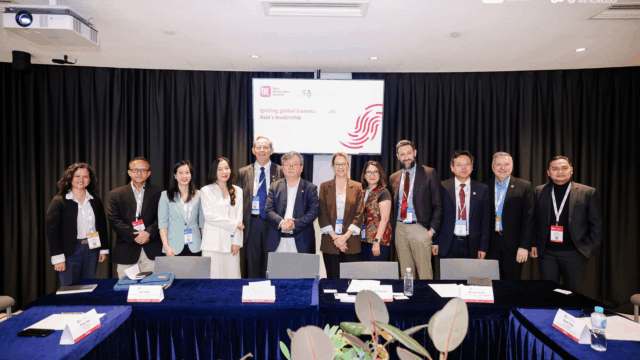
As one of Indonesia’s leading universities in the fields of computer science and information systems, BINUS University was invited to contribute insights and best practices on ethical Artificial Intelligence (AI) governance. Representing the university, Vice-Rector Rini spoke at the Private Leadership Meeting for Vice-Presidents in a panel session titled “Who Watches the Watchers? Forging a Global Consensus on Ethical AI Governance.”

(Photo Editor: Mufti Warits)
“Generative AI is transforming the way we teach, learn, and collaborate, so ethical AI governance should not slow down innovation but rather guide it responsibly. At BINUS, we see AI as a learning companion and co-pilot that can enrich education when supported by adaptive, human-centered governance frameworks that continue to evolve alongside technological change,” she noted.
AI has long been integrated into learning and operational systems at our campuses. Through the active involvement of our AI experts, we continuously encourage responsible AI practices by providing education and implementation guided by ethical standards set by the ethics committee.
Of course, no system is perfect, and challenges can still arise in practice. Acknowledging this, Vice-Rector Rini shared that “We believe responsible AI implementation also requires strong institutional accountability. That is why the ethics committee at BINUS University actively reviews ethical violation cases, conducts hearing sessions when needed, and recommends disciplinary actions whenever there are legitimate grounds for further action.”
(Photo Editor: Mufti Warits)
Even though BINUS has already implemented monitoring systems and preventive measures for the application of AI within our community, we must continue adapting to the rapid advancement of AI. This includes updating regulations and continuously strengthening AI literacy through curriculum integration, as well as developing an AI competency framework, as discussed in UNESCO’s 2025 report, making these efforts increasingly essential for higher education institutions worldwide.
Amid these rapid changes, the discussions throughout the summit also became a valuable opportunity for us to exchange perspectives, experiences, and best practices with global educators, policymakers, and industry leaders on how higher education institutions can respond to rapid technological transformation. Rather than focusing solely on AI adoption, the forum also brought attention to the importance of interdisciplinary collaboration and stronger cross-sector strategic partnerships in shaping innovation that is relevant, responsible, and impactful.
Therefore, as AI continues to reshape industries, education, and the future workforce, we at BINUS University are reminded that the future of education lies in balancing innovation with human-centered values, while strengthening adaptive learning ecosystems that foster critical thinking, ethical awareness, and interdisciplinary competencies.
Author:
Mita Adhisti
Editor:
Aninda Rahmasari

Comments :